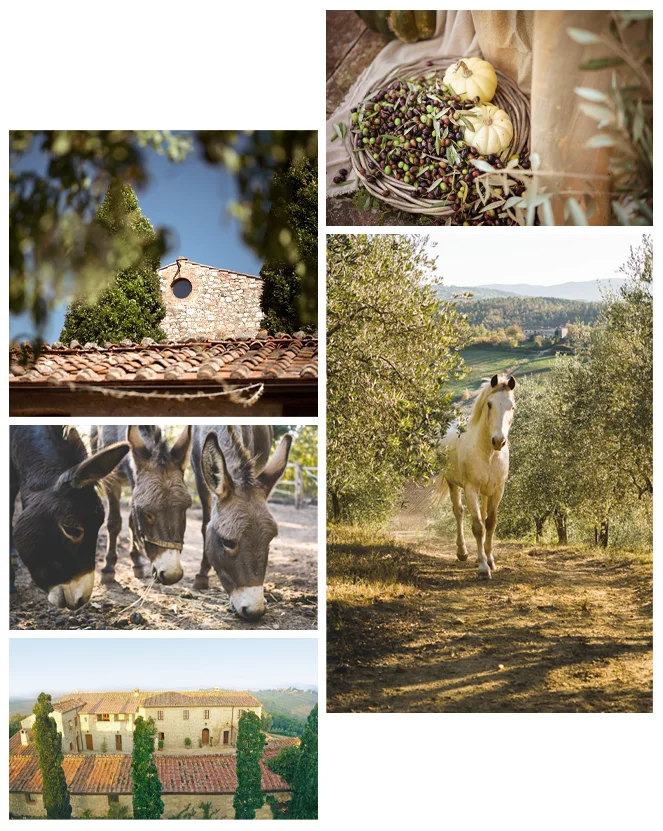
Originally a walled castle which was turned into a Benedictine monastery in the twelfth century, Montecastelli is located on an ancient road known as La Francigena. Its beautiful hilltop location has been a stopover for many pilgrims, soldiers and merchants long before today's owner, Jens Schmidt decided to revive the art of hospitality in this 1000 year old hamlet between Siena and San Gimignano. The 'Via Francigena', earlier known as 'Via Romea' was developed under the rule of the Longobards (8th - 12th c.) who sought to connect their Frankish empire with the spiritual capital of Rome. Eventually this road reached as far as Canterbury in England. And it was Sigeric, the Archbishop of Canterbury who made the Francigena Road famous in a detailed description in his diary written during his journeys in 994. However, the earliest mentioning of the Francigena goes back as far as 600 AD. In his diary Sigeric mentions Monteriggioni and Abbadia a Isola calling it 'Borgonuovo'. He describes the road continuing from Borgonuovo to the Elsa river, mentioning Strove, only a few kilometers from Montecastelli, passing by various hamlets and castles, one of them most likely being Montecastelli, a castle-fortress in existence well before year 1000, as many clerical and tax records document. Montecastelli's dominating position over the Elsa river, with its 360° views is witness to its past as a military fortress. Four foot wide walls with shooting holes and a still readable floor plan of the original rectangular fortress, cut-stone arched entry ways and the unique filaretta hand-hewn stonemason technique still speak the language of the hard labor of life and craftsmanship in the Middle Ages. Traces of the old Francigena Road are still visible in the adjunct Montagnola, a nature reserve, and also on the circuitous way leading up to the back entrance of Montecastelli, where a cobblestone path can be seen. On old maps this is the old road that connected Strove and the Pieve a Castello (just below Montecastelli) and most probably the road that the Archbishop of Canterbury traveled more than 1000 years ago. An exact roadmap for the Francigena Road does not exist, as many parallel roads developed over time due to parts that were abandoned or unusable. However it is most probable that the path passing by Montecastelli would be the oldest route as it is along the hillside, avoiding the low-lying swampy areas, which were later drained to make travel easier. Today, departing from Abbadia Isola, Castel Pietraio or Montecastelli one may explore for one's self the Francigena Road, now a European hiking path (101 + 106), into the Montagnola Reserve, which begins just behind Montecastelli and continues for another ten miles of uninterrupted mountains and spectacular nature, with the reminder that one is not the first to stop along this path, as one passes by the occasional ruin of a medieval church or abandoned castle wall. |
| |
Francigena Road
Francigena Europe Map
The Original Entry - circa 1000 AD
Lion's Head Fountain
The Old Well
|